How does MiTOS2 annotate the origin of replication of the heavy strand and that of the light strand? I have not been able to find out the answer to these questions in either of the two references provided.
Hello @hnf1957
Hopefully I can help!
This shared history has an example in the dataset tagged with tool-test-2.
You can import the history, then review how the tool form parameters and inputs were set up by using the rerun icon.
Screenshot of what to look for in the output using the eye icon instead:
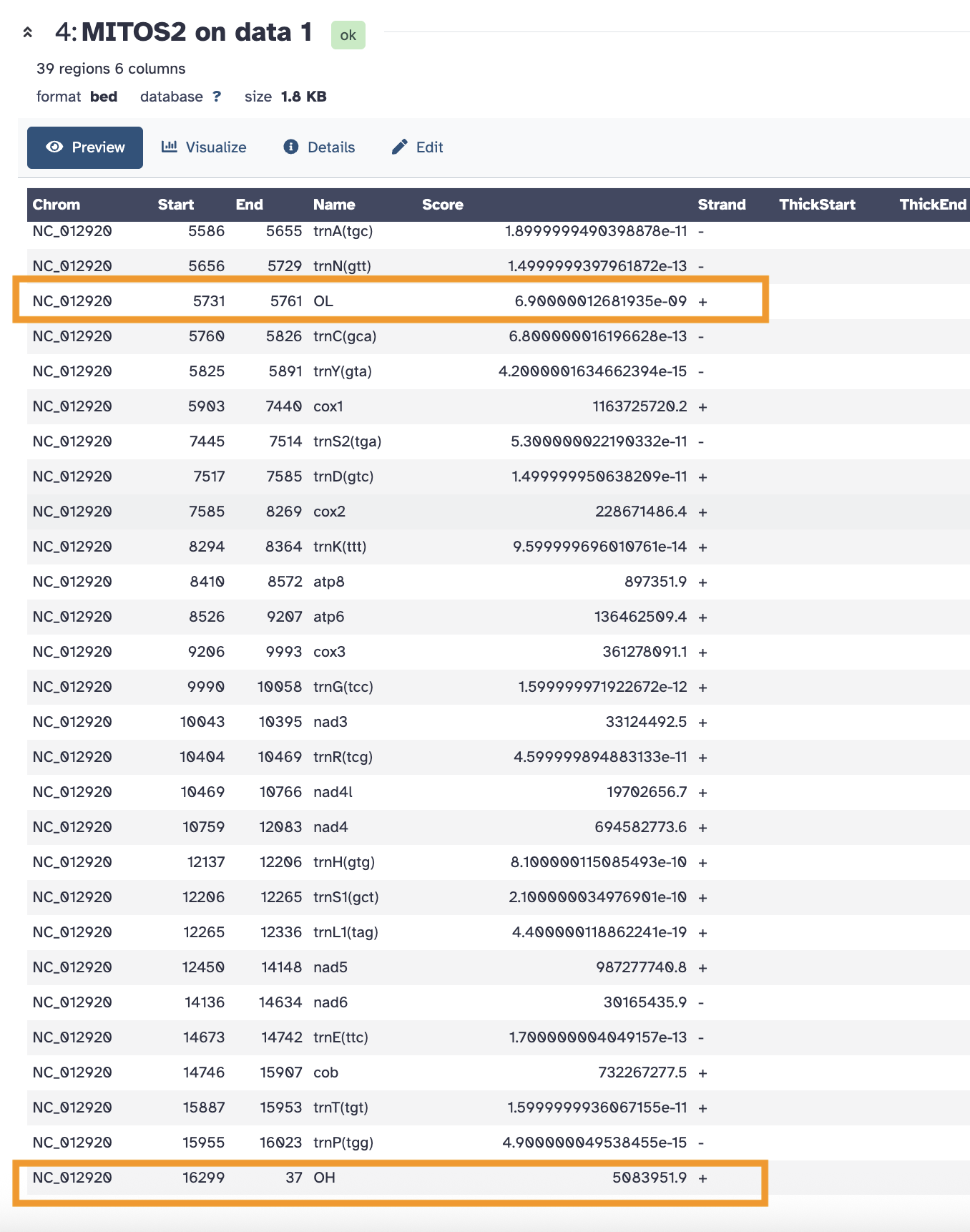
Hope this helps! 
Sorry! I am now aware that my question may have been a bit confusing. I was not asking how to instruct MITOS2 to look for origins of replication, but how the program actually does it. In the meantime, I have found this sentence in a paper by Spradling et al., 2021 ( Mitochondrial genome of Geomydoecus aurei, a pocket-gopher louse ): MITOS2 uses BLASTN to identify origins of replication of the heavy strand, and a covariance model built from a manually curated set of all light-strand origins of replication annotated in RefSeq 65 (Alexander Donath, personal communication).
I would very much appreciate getting something more “public” than a personal communication on this respect.
Hi @hnf1957
Thanks for clarifying!
Scroll down into the Help section at the bottom of the form.
- There will be short summarized guidance for usage and how the tool functions.
- And links to the original authors publications and any supplemental resources they might host.
 GTN Tutorial links (if the tool is included in any).
- Selected prior Q&A at this forum – a search with the tool name here will probably find more!
The authors host this website:
Which links to the original publication here
Citation : M. Bernt, A. Donath, F. Jühling, F. Externbrink, C. Florentz, G. Fritzsch, J. Pütz, M. Middendorf, P. F. Stadler
MITOS: Improved de novo Metazoan Mitochondrial Genome Annotation
Molecular Phylogenetics and Evolution 2013, 69(2):313-319 link
And the Gitlab development repository
I’m having trouble linking through to the publication text right now – maybe it is impacted by the AWS issues going on right now across the web. If that is the problem, I expect it will resolve in a day or so.
And for this question:
The author might be able to clarify a bit more. Hi @bernt-matthias would you have time to add some comments? Thanks! 
Dear @hnf1957.
Unfortunately the manuscript describing this detail is unpublished.
- For the OL MITOS2 uses a curated covariance model which is employed using infernal.
- For the OH we use
blastnagainst the OH annotated in RefSeq
Results for non-Chordates should be considered with caution.
Let me know which level of detail you need. Essentially, for the OL we use the same approach as for the rRNAs (just with a different model) and for the OH we use the same methods as for the proteins (replacing blastx by blastn)
Thank you very much for your feedback, @jennaj and @bernt-matthias. I don’t need further details.
Best wishes,
Horacio